Most marketplace founders think about SEO the same way a blog thinks about SEO: write content, publish it, wait for rankings. That approach works for media companies. It is the wrong model for a marketplace.
Marketplaces have a structural SEO advantage that most other businesses do not. Your supply data already contains everything required to build thousands of high-intent landing pages. Locations. Categories. Supplier profiles. Use cases. Price ranges. Every combination of those attributes is a search someone is making.
The founders who build this well end up with an organic acquisition engine that gets stronger as their supply grows. Every new supplier, every new city, every new category adds more surface area. The content compounds without anyone writing it.
That is what programmatic SEO is. And it is the most defensible SEO moat a marketplace can build.
Programmatic SEO, Defined
Programmatic SEO is the practice of building page templates that generate unique, useful pages at scale from structured data. In a marketplace context, that data is your supply.
The pages are not copied or duplicated. Each one is unique because each supplier, location, and category is different. The template handles layout and structure. Your data fills in the substance.
Examples of programmatic pages in a photography marketplace:
- "Wedding photographers in Austin, TX"
- "Family photography under $200 in Seattle"
- "Commercial real estate photography for listings"
- "John Smith Photography | Portraits and Events in Chicago"
None of those required a writer. They required a template, structured supply data, and a publication system.
The Four Core Page Types
Location Pages
Location pages target the geographic intent in every service category search. "Event photographer in Denver" is different from "event photographer in Portland." Buyers searching with city names have high purchase intent. They are ready to evaluate options.
Effective location pages include:
- A meaningful headline with the city and category
- Actual supply from that location, or nearby
- Reviews and social proof from local transactions
- Supporting content about the category and what buyers should look for
- Internal links to adjacent cities and categories
The mistake most founders make is building location pages with no real supply. Empty pages rank briefly and then drop. Google penalizes thin location content aggressively. The page needs enough supply to be genuinely useful.
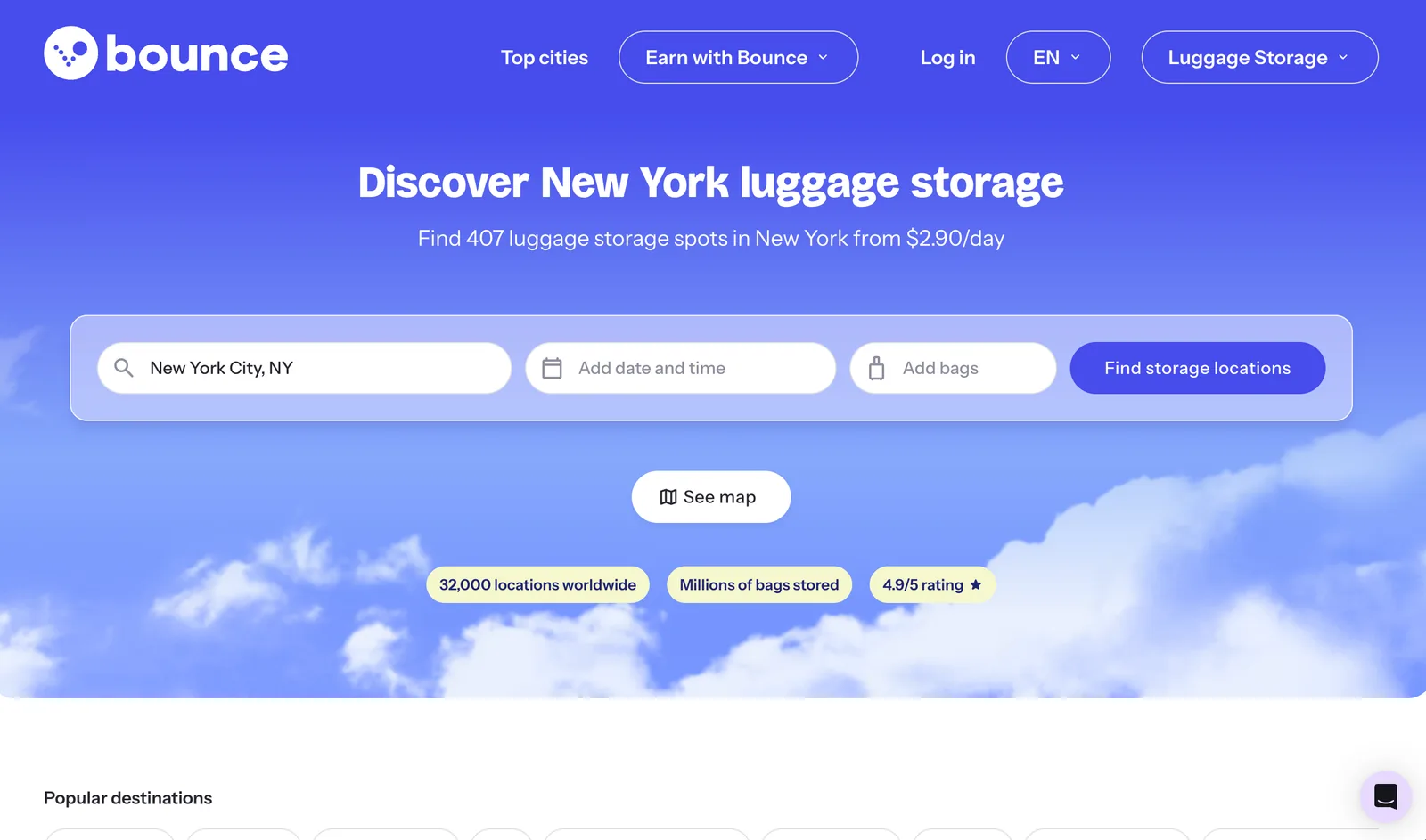
The luggage storage marketplace Bounce runs this play cleanly. One location template, bounce.com/luggage-storage/{city}, scales to every market they operate in: New York, London, Paris, and hundreds more. Each page captures the high-intent "luggage storage [city]" search and fills the template with the actual storage locations available in that city. The structure is identical everywhere. The supply is what makes each page unique and useful.
Category Pages
Category pages target the broad intent searches at the top of the funnel. "Wedding photographers" before a buyer has picked a city. "Corporate headshot photographers" before they have a budget in mind.
These pages perform best when they include:
- Category-level filtering and navigation
- Supply previews that load quickly
- Buyer education content that explains what differentiates good from average in the category
- Price range guidance
- Links into more specific location and use-case pages
Category pages build topical authority. They signal to search engines that you are a real resource for the category, not just a thin directory.
Supplier and Listing Profile Pages
Individual supplier pages are among the most underutilized SEO assets in marketplaces. Every active supplier is a unique, crawlable page that can rank for their name, their specialty, and their location.
A well-structured supplier profile includes:
- Unique content: bio, specialty, pricing, coverage area
- Booking signals: reviews, response rate, completed jobs
- Structured data markup for the service category
- Natural internal links to their location and category pages
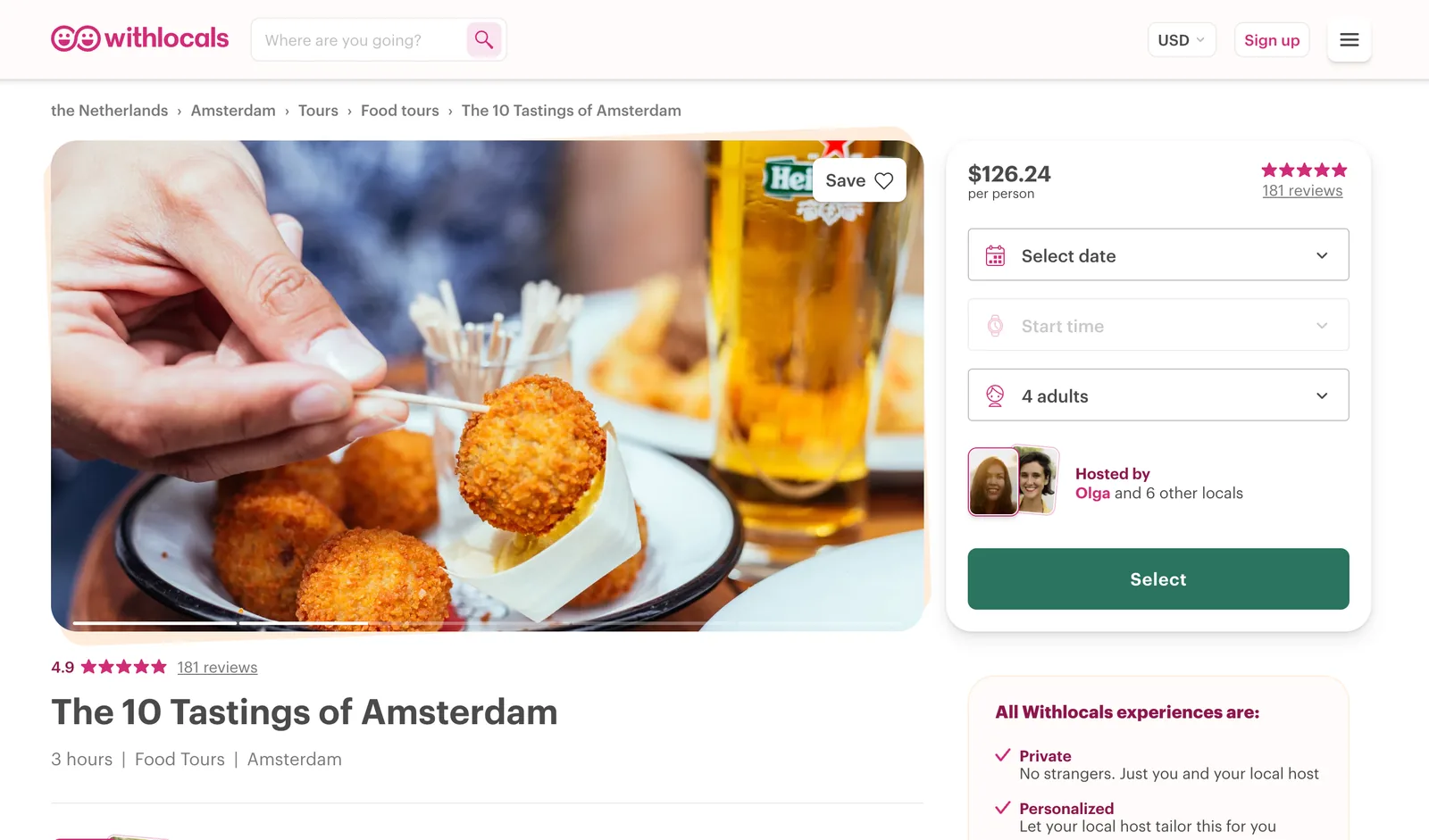
The experiences marketplace Withlocals builds a dedicated page for every listing, like its "10 Tastings of Amsterdam" food tour at withlocals.com/experience/{experience-name-id}. Each page carries the unique description, photos, host, price, and reviews for that one experience, so it can rank both for the named tour and for broader "food tour Amsterdam" intent. Multiply that across thousands of active listings and you have thousands of ranking pages that no one had to write.
These pages also create a compounding dynamic. As your supply grows, your indexed page count grows. As your indexed page count grows, domain authority grows. As domain authority grows, category and location pages rank better.
Use-Case Pages
Use-case pages target the intent-specific searches that sit between broad category and specific location. "Real estate photography for listings." "Headshots for LinkedIn." "Event photography for corporate conferences."
These pages work well because:
- Buyers searching use cases are past the discovery phase
- Competition is lower than head category terms
- Supply relevance is higher because you can show the right suppliers
- They build topical depth that reinforces category authority
The camping marketplace Hipcamp uses this with its "rv parks near me" page. The modifier "near me" targets a distinct intent that sits beside the core RV park category, where competition is lower and the buyer is closer to booking. The same template can spin up modifier pages for "pet friendly," "with hookups," or any other attribute their supply data already tags, each one a separate page for a separate search.
The Thin Content Trap
Building programmatic pages at scale creates one significant risk: thin content. The same supply quality standards that protect buyer trust on your platform (defining the right supply) apply to the pages you build from that supply.
Google defines thin content as pages that provide little or no value to users. Programmatic pages become thin when the template is strong but the underlying data is weak. A location page with two suppliers and no reviews. A category page with three listings and no supporting copy. A supplier profile with no description and a stock photo.
Thin content at scale is worse than no content. It generates crawl budget waste, contributes to algorithmic penalties, and can suppress rankings on your best pages.
The threshold for publishing a programmatic page should be defined before you build the system. Minimum supplier count. Minimum review count. Minimum content fields populated. Pages that do not meet the threshold stay unpublished, or redirect to their parent category, until they do.
This is the discipline most founders skip. They build the system and publish everything. The pages look fine from the CMS. They perform badly in search.
Internal Linking: How Authority Gets Distributed
Building programmatic pages is not enough. Those pages need to be connected to each other and to your highest-authority pages.
Internal linking is how search authority flows through a marketplace. Your homepage passes authority to category pages. Category pages pass authority to location pages. Location pages pass authority to supplier profiles.
The hierarchy:
- Homepage links to major category hubs
- Category hubs link to sub-categories and top location pages
- Location pages link to nearby cities and relevant supplier profiles
- Supplier profiles link back to their category and location pages
Related listing widgets, "suppliers you might also like" modules, and "more in [city]" navigation all contribute. Every link tells search engines which pages are related and valuable.
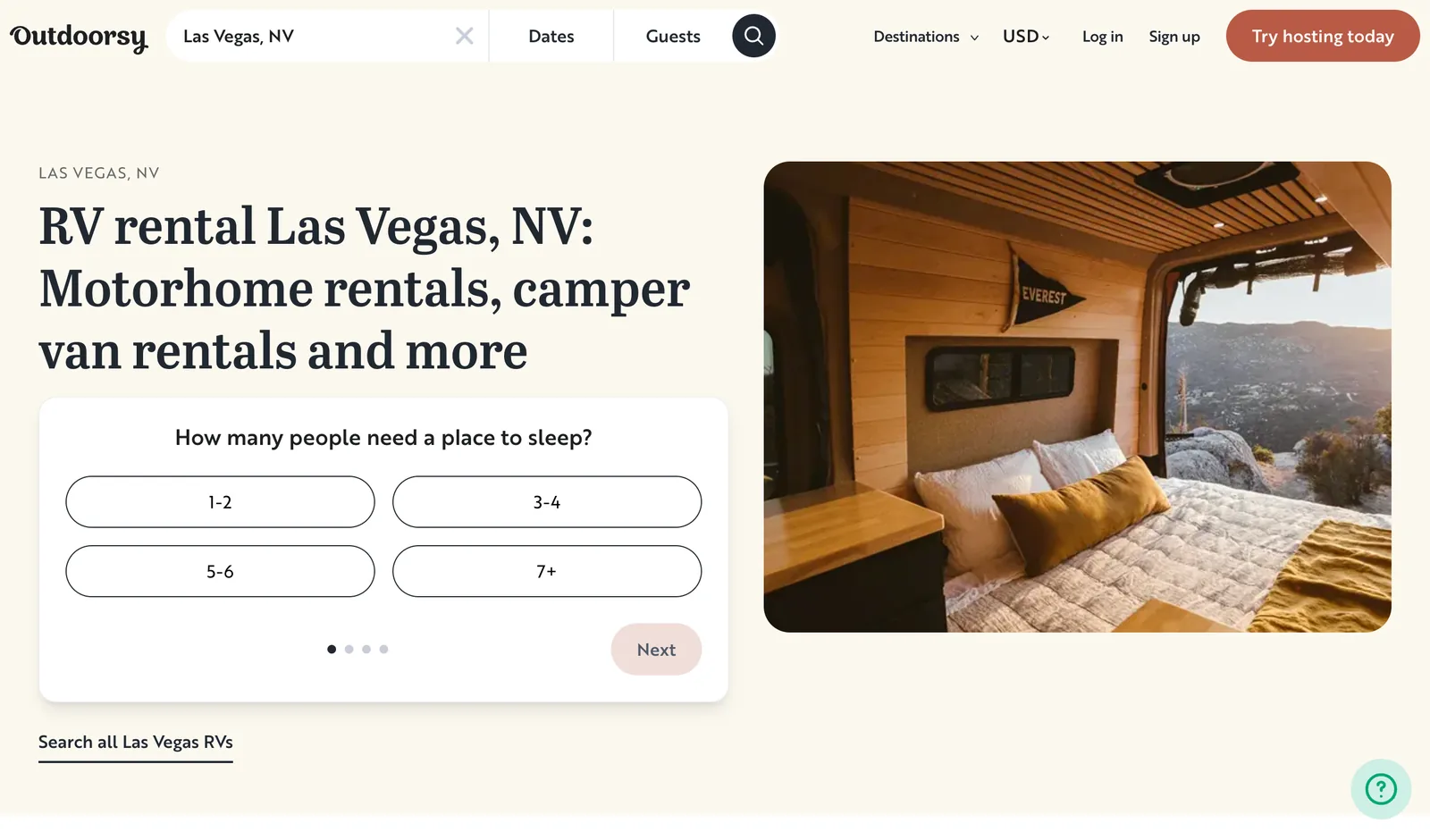
The RV rental marketplace Outdoorsy shows the hierarchy in its URL structure: outdoorsy.com/rv-rental/{state}/{city}. The state page acts as a hub that links down to every city within it, and each city page links back up to the state and out to individual RV listings. That nesting is exactly the homepage to category to state to city to listing chain that lets authority flow down the tree and accumulate where it converts.
Most marketplaces underinvest in internal linking infrastructure and then wonder why their location pages do not rank despite good content.
Building This Without a Content Team
The operational advantage of programmatic SEO is that it does not require writers.
What it does require:
- A template system that generates pages from structured data
- Structured data: supplier profiles with complete fields, location tagging, category taxonomy
- A quality threshold enforcement system that prevents publishing below the bar
- A monitoring system to track indexed pages, ranking changes, and page performance
Execution splits into two tracks. The engineering team builds the template and publication infrastructure. The supply operations team ensures supplier profiles are complete enough to power the templates.
The lever for more pages is not more writing. It is better supply data quality and more active supply.
The Compounding Advantage
Programmatic SEO is not fast. The first pages take months to index and rank. But the compounding works differently from paid acquisition. This is the same mechanic behind how the marketplace flywheel builds momentum: each improvement reinforces the next, and the system gets harder to displace over time.
A paid channel stops producing when you stop paying. An organic channel continues producing, and in most cases accelerates, as your page count grows, your reviews accumulate, and your domain authority builds. Every new supplier who fills out a complete profile adds a new indexable page. Every review left on a booking improves the relevance signals on that page.
At $5M GMV, a well-built programmatic SEO system might drive 10 to 15 percent of bookings organically. At $15M GMV with the same system in place, that percentage can reach 30 to 40 percent while CAC from paid channels climbs.
The organic engine gets stronger as the marketplace grows. The paid dependency weakens as the organic engine matures.
Most marketplace founders start building this too late. The right time is when you have enough active supply to generate pages that meet your quality threshold. For most marketplaces, that is earlier than it feels.
Where to Start
- Audit your current supply data. Identify which fields are consistently populated and which are empty. The template is only as good as the data.
- Define your quality threshold before you build. Minimum supplier count, review count, and content completeness before a page publishes.
- Build location and category pages first. These have the broadest search volume and the highest impact on domain authority.
- Establish your internal linking architecture before you launch at scale.
- Monitor indexed page counts and ranking performance by page type monthly.
Programmatic SEO rewards founders who build the system once and then let supply growth do the work. That is a better investment than a content calendar.
As AI search continues to grow, programmatic content also feeds into AEO and GEO visibility. The same authoritative, structured pages that rank in Google become the sources AI systems cite when buyers ask questions in ChatGPT or Perplexity.
If you are building this as part of a broader growth and SEO strategy, the programmatic foundation is usually the first thing worth getting right.