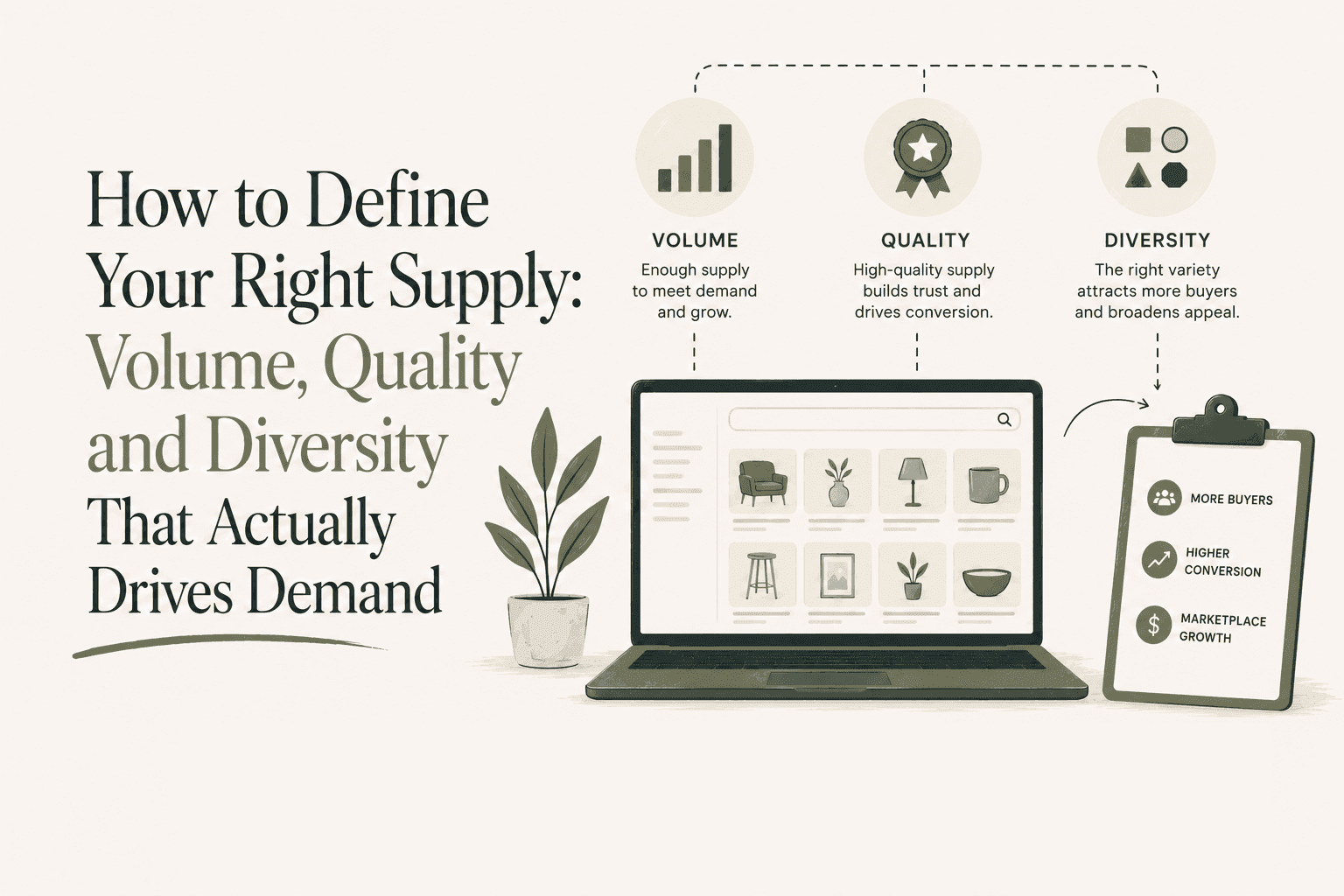
Supply drives the entire marketplace experience. Poor supply management undermines all other platform investments, resulting in sluggish responses, inconsistent quality, and off-platform transactions.
The instinct to grow supply as fast as possible is understandable but wrong. The goal is not more supply. It is the right supply. And defining what "right" means for your marketplace is one of the most important strategic exercises you can do early.
Volume: Market Density
Effective volume means achieving sufficient supplier density within specific geographic areas or categories to create genuine liquidity.
You need enough options so users always feel like they can find something. Not infinite options. Just enough that search results feel full and competitive pricing can emerge naturally.
DoorDash's early learning demonstrates this principle clearly. Cities with 100 restaurants generated dramatically different user experiences than those with 15. More variety, better proximity, stronger unit economics. They learned to achieve local density before expanding geographically.
The mistake most founders make is spreading supply too thin across too many markets or categories at once. It looks like growth. It produces weak liquidity everywhere.
Quality: The Trust Foundation
Supply quality directly influences conversion rates and customer retention. Your supply is your product. This is not a metaphor.
Marketplace operators establish quality standards through:
- Onboarding frameworks that define what excellence looks like
- Listing presentation tools
- Search structure and filtering
- Policy enforcement
- Response-time requirements
Airbnb exemplifies this approach. Their professional photography programs, cleanliness standards, host verification, and pricing tools shifted customer perception through improved supply presentation. They did not rebuild the product. They raised the bar on how supply was presented and what was expected.
You need to do the same. Not just accept suppliers who apply, but actively shape how they show up.
Diversity: Market Segmentation
Successful marketplaces need multiple price points, formats, and quality tiers to serve varied customer preferences and expand the addressable market within individual categories.
A marketplace with only premium supply misses buyers who would convert at mid-tier prices. A marketplace with only budget supply misses the customers with higher willingness to pay who drive stronger unit economics.
Diversity is not about having something for everyone. It is about having real options across the segments that exist in your market.
Supply Engagement: Activated vs. Passive
Inactive suppliers damage marketplace viability. The distinction between activated and passive supply is one of the most underappreciated dynamics in early marketplace operations.
An activated supplier responds quickly, maintains accurate availability, prices competitively, and delivers a consistent experience. A passive supplier has a listing but rarely converts.
Critical engagement metrics:
- Response times
- Booking acceptance rates
- Availability consistency
Activated supply is worth 10x passive supply. That is not an exaggeration. Dormant suppliers should face removal, or at minimum, be deprioritized in search until they demonstrate engagement.
Anti-Disintermediation: Keeping Transactions On-Platform
Platform leakage occurs when suppliers direct customers off-platform to avoid your take rate. It deteriorates GMV, revenue stability, and liquidity. It is also a signal that your platform is not delivering enough value to justify the transaction fee.
Effective prevention mechanisms include:
- Escrow and protected payment systems
- Platform-exclusive tools and integrations that make the experience better than going around you
- Clear contractual agreements
- Dispute resolution frameworks
- Loyalty incentive structures
The best anti-disintermediation strategy is not enforcement. It is making the platform so valuable that off-platform transactions feel risky and inconvenient. Build toward that.
Defining "Right" Supply
When you put all of this together, right supply means:
- Sufficient density to create genuine liquidity in your target markets
- High enough quality to convert and retain buyers
- Diverse enough to cover the real segments in your category
- Engaged enough to respond, fulfill, and show up consistently
- Loyal enough to stay on-platform
Getting this right takes longer than most founders expect. But it is the foundation everything else is built on.