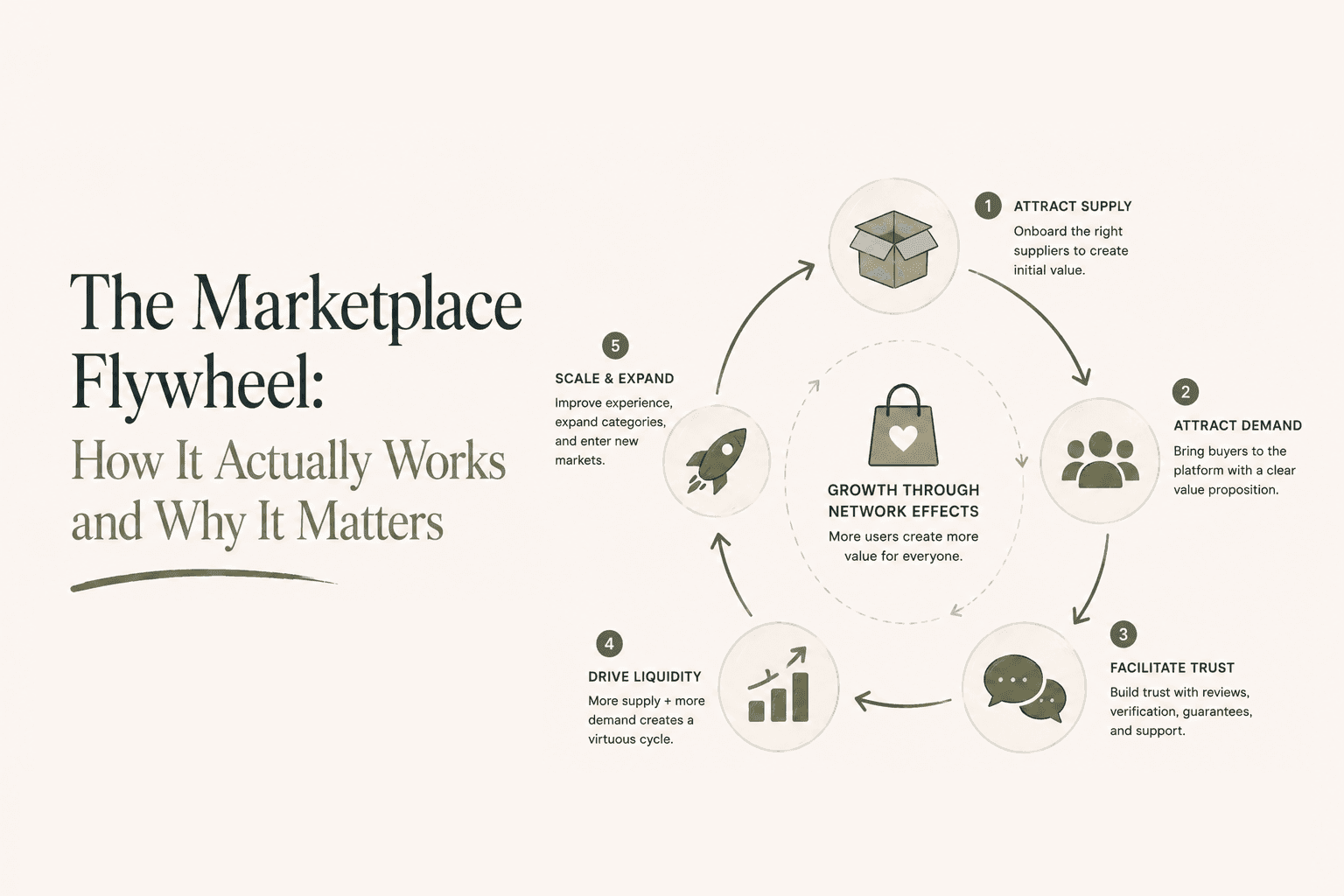
Building a marketplace presents unique challenges because these businesses operate as interconnected systems rather than linear models. The core engine driving successful marketplaces is the flywheel, a self-reinforcing loop where multiple smaller flywheels work together to strengthen supply growth, trust, and retention.
In its simplest form: more supply leads to better selection, which leads to more demand, which leads to more bookings, which leads to higher earnings, which leads to more supply.
But real-world marketplaces face uneven growth patterns across different markets and categories. Founders must identify where their wheel accelerates versus where it encounters resistance.
The Four Pillars of a Working Flywheel
1. Supply Quality
Quality surpasses raw quantity. Users prioritize having appropriate inventory in their specific location over extensive but sparse selection. High-quality listings boost conversion, retention, and confidence better than volume alone.
2. Demand Intent
Traffic differs fundamentally from genuine demand. High-intent demand generates bookings and motivates supply participation. Intent varies significantly by geography. Some markets show purchase-ready behavior while others display low-conversion browsing patterns.
3. Trust and Safety
Trust functions as the structural foundation. When trust erodes, sellers and buyers both churn, disputes multiply, and the economic model deteriorates. Trust requirements vary across regions and demand localized approaches.
4. Efficient Matching
Matching determines how quickly supply and demand connect. Search functionality, ranking algorithms, filters, recommendations, and pricing all influence conversion rates. Strong matching requires sufficient local inventory density to provide meaningful buyer choices.
How the Flywheel Starts
The critical early challenge involves breaking initial stagnation. Insufficient supply to attract demand. Insufficient demand to attract supply.
A common mistake involves expecting simultaneous growth on both sides. Instead, supply-first strategies typically succeed because demand exhibits greater volatility. Buyers arriving to poor selection rarely return, while sellers demonstrate greater patience waiting for demand to materialize.
The recommended approach concentrates efforts on a narrow wedge: one market, one category, one customer segment. This focused strategy builds local liquidity, which ignites the entire system. Once one market achieves sustainable momentum, the successful playbook becomes replicable.
Where Flywheels Break
Flywheels don't simply decelerate. They can reverse into negative loops that create downward spirals.
Supply Earnings Collapse: Low utilization generates inadequate income, causing frustration and departure. As suppliers leave, selection weakens, demand satisfaction drops, and utilization declines further, accelerating the downward cycle.
Demand Cannot Find Appropriate Options: Poor selection creates low conversion and expensive paid acquisition. As demand acquisition becomes harder, funnel efficiency deteriorates and cost-per-booking increases.
Excessive Friction: Suboptimal search, inconsistent pricing, delayed communication, and confusing onboarding all reduce trust and completion rates. These friction points compound across the entire experience.
Trust Deterioration: Fraud, misrepresented listings, disputes, and unreliable payouts damage confidence. Predictable compensation is essential for supplier retention. Payment delays or inconsistencies cause faster disengagement than most other factors.
How to Accelerate the Flywheel
Improve Matching: Enhanced ranking models, stronger filters, instant booking options, predictive search, and better categorization accelerate conversion and improve earnings simultaneously.
Increase Take Rate Sustainably: Rate increases work when users perceive added value: buyer protection, reduced friction, predictable demand for suppliers, seller management tools, enhanced trust signals, and superior UX compared to off-platform transactions.
Strengthen Supply Earnings: Optimization strategies include correcting pricing, aligning availability with peak demand, reducing cancellations, eliminating off-platform leakage, tightening gross-to-completed GMV spreads, and providing performance analytics.
Expand Into Adjacent Markets: Expansion is a reward for initial success. Smart growth targets nearby geographies with existing demand overflow, new categories that current suppliers can serve, similar customer segments, or opportunities identified through power-user analysis.
Signals That Your Flywheel Is Spinning
Rising Conversion in Specific Markets: Buyers locate desired inventory, pricing aligns appropriately, and matching continuously improves without manual intervention.
Predictable Supply Earnings: Sellers experience consistent bookings and remain engaged independently of direct support.
Organic Demand Retention Without Incentives: Users return because the experience delivers value, not due to promotional encouragement.
Stable Operational Load: Support requests, cancellations, and disputes decline relative to GMV growth.
Flattening or Declining Acquisition Costs: Marketing efficiency improves as conversion strengthens and marketplace confidence grows.
Metrics That Prove Market Readiness for Scaling
Before expanding, look for these signals:
- Strong Net GMV Growth: Completed GMV demonstrates actual transaction closure driven by matching improvements and supply density.
- Healthy Gross-to-Completed GMV Spread: Tightening spreads indicate fewer cancellations, reduced refunds, lower fraud, and superior operational execution.
- High Intent Conversion: Strong search-to-booking conversion reveals whether users locate desired options and trust the platform.
- Predictable Supply Earnings: Stable compensation signals a healthy local flywheel.
- Declining Paid Acquisition Reliance: Increased organic activity indicates genuine flywheel momentum rather than paid-channel dependency.
- Improving Trust Metrics: Fewer disputes, reduced cancellations, faster resolution, and consistent payouts demonstrate user safety perception.
Key Takeaways
Early-stage operators should prioritize:
- Concentrated market focus that demonstrates genuine liquidity before expansion
- Supply quality as the primary acceleration lever
- Tightening gross-to-completed GMV leakage
- Early trust and safety investment
- Obsessive matching efficiency optimization
The marketplace flywheel operates powerfully but requires intentional building and resistance to premature scaling. Once properly established, momentum compounds, user engagement deepens, and the business develops self-sustaining growth patterns.