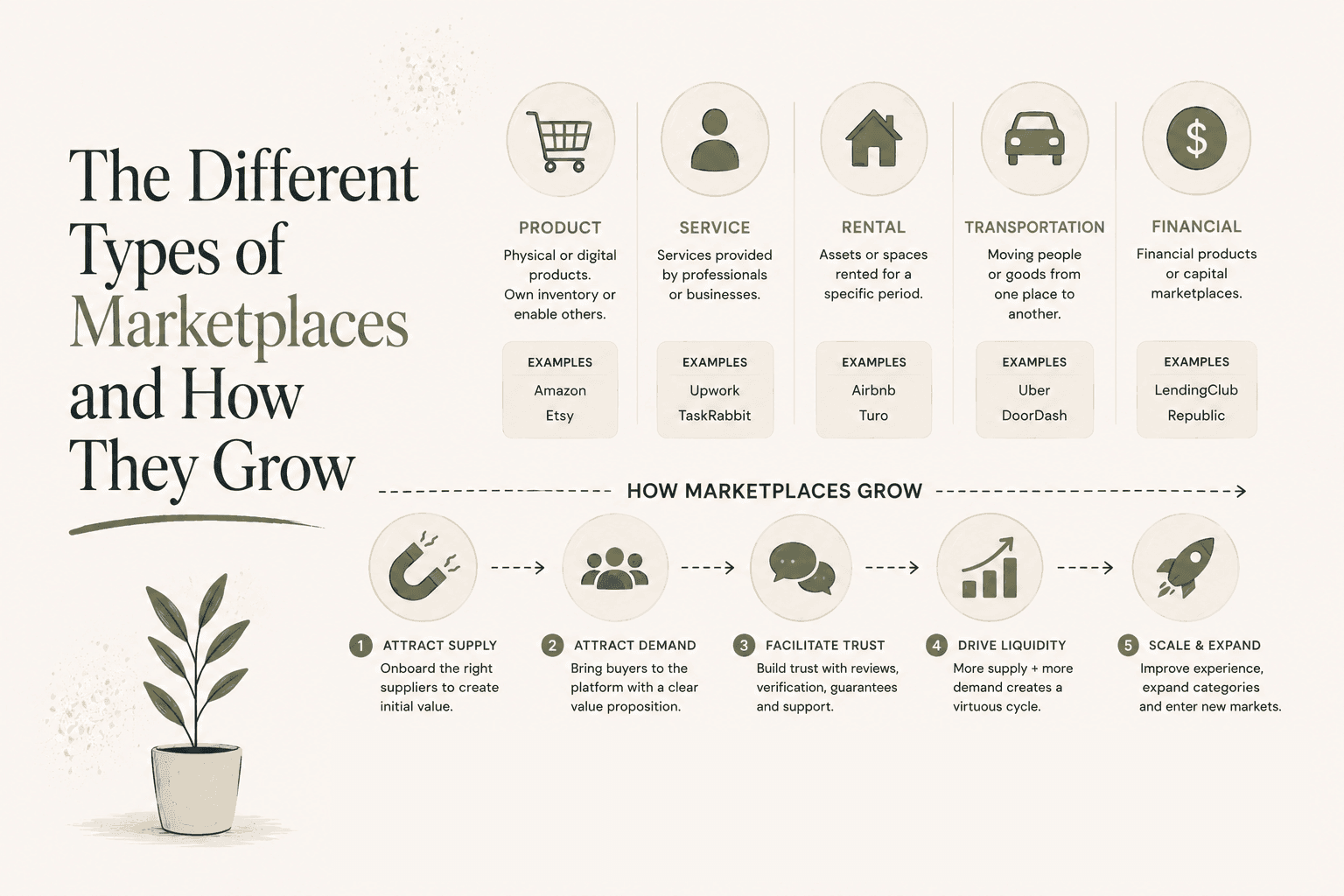
Marketplaces appear similar externally but develop through distinct mechanisms. While the fundamental concept seems straightforward (connecting supply with demand and collecting fees), the actual dynamics shift significantly based on marketplace structure.
Key variables affecting growth include whether the model is horizontal or vertical, B2B or B2C, product or service-focused, and built for high or low frequency transactions. These factors influence unit economics, liquidity approaches, trust requirements, expansion velocity, and scaling methodologies.
The wrong playbook in the wrong category slows growth fast. Understanding your type is not optional.
High Frequency vs Low Frequency Marketplaces
High Frequency
Examples: Uber, DoorDash, Instacart, TaskRabbit
High frequency marketplaces thrive when users return regularly, often daily or weekly. Characteristics include:
- Strong retention loops through habit formation
- Rapid liquidity with constant supply-demand activity
- Repeatable revenue streams enabling predictable forecasting
- Minimal seasonality with consistent usage patterns
- Fast feedback cycles supporting rapid iteration
These models demand operational excellence. Performance must be reliable consistently to maintain user habits. One bad experience in a high-frequency product has outsized consequences because users will encounter the next competitor immediately.
Low Frequency
Examples: Airbnb, Getmyboat, Hipcamp, Turo, The Knot
Low frequency marketplaces serve customers returning several times yearly or infrequently. Key characteristics:
- Slower feedback loops delaying organizational learning
- Pronounced seasonality connected to travel or life events
- Higher average order value per transaction
- Dependence on superior supply quality
Success requires emphasis on supply density, search accuracy, pricing precision, and brand credibility. Paid marketing alone rarely builds a low-frequency marketplace. The product has to earn the repeat visit.
Horizontal vs Vertical Marketplaces
Horizontal
Examples: Craigslist, Facebook Marketplace, eBay, Mercari
Horizontal marketplaces span multiple categories with broad appeal. Growth relies on:
- Extensive SEO presence
- Minimal moderation encouraging easy listing creation
- Low-friction posting processes
- Viral or social adoption mechanisms
Liquidity is broad but shallow. Some supply everywhere, with insufficient density for exceptional category-specific experiences.
Vertical
Examples: Getmyboat, Outdoorsy, Reverb, Faire
Vertical marketplaces specialize in single categories and deliver curated experiences. Growth depends on:
- High-quality, well-managed supply
- Robust trust and safety mechanisms
- Category specialization rather than breadth
- Repeatable experiences that encourage returns
- Full journey ownership from discovery through checkout
Vertical liquidity concentrates deeply within narrower markets, often outperforming horizontals through the power of specialization. You know your buyer and your seller better than anyone.
B2B vs B2C Marketplaces
B2C
Examples: Uber, DoorDash, Etsy, Airbnb
B2C marketplaces serve individual consumers on the demand side. Growth characteristics:
- Rapid feedback loops enabling quick iteration
- Higher marketing expenditure due to competitive acquisition
- Straightforward onboarding processes
- Notable seasonal demand fluctuations
- Higher churn risk from easy platform switching
Success comes through conversion optimization, habit development, and trust establishment.
B2B
Examples: Faire, Alibaba, Convoy, Toptal
B2B marketplaces connect businesses on both sides with greater operational complexity. Characteristics:
- Extended sales cycles requiring education and relationship building
- Strong retention once businesses commit
- Deep integration with existing business systems
- Enterprise-level trust, compliance, and financial requirements
- Superior margins from higher-value transactions
Growth occurs slowly initially but becomes highly defensible through workflow embedding and increased switching costs.
Product vs Service Marketplaces
Product
Examples: Mercari, Depop, The RealReal, The Pros Closet
Product marketplaces facilitate goods transactions. Common growth challenges:
- Category inventory availability
- Goods quality and authenticity assurance
- Fraud and counterfeit prevention
- Shipping and return logistics
- Accurate listing standards
Success depends on trust systems, ratings, authentication processes, and reliable logistics.
Service
Examples: TaskRabbit, Rover, Handy, Turo, Sittercity
Service marketplaces connect people through availability, expertise, or asset access. Growth challenges:
- Accurate skills and availability matching
- Real-time scheduling coordination
- Provider reliability consistency
- Geographic price variability
- Managing time slots as perishable inventory
Service marketplaces require stronger liquidity than product counterparts. Unused time slots cannot be recovered. Every no-show or cancellation is permanent lost revenue for both sides.
Matching Growth Strategy to Marketplace Type
Different marketplace types follow distinct growth patterns:
- Horizontal platforms grow through volume and minimal friction, expanding the funnel broadly.
- Vertical platforms expand through specialization, trust, and expertise-driven conversion.
- B2C platforms achieve growth via habit loops and optimized user experiences.
- B2B platforms succeed through workflow value integration and enduring relationships.
- Product marketplaces rely on trust systems and logistics optimization.
- Service marketplaces depend on matching precision and provider dependability.
- High frequency models scale through repetition and friction reduction.
- Low frequency models expand through search optimization, brand trust, and seasonal performance excellence.
Understanding your type tells you which of these levers to pull first, and which ones to ignore entirely until you have the fundamentals working.