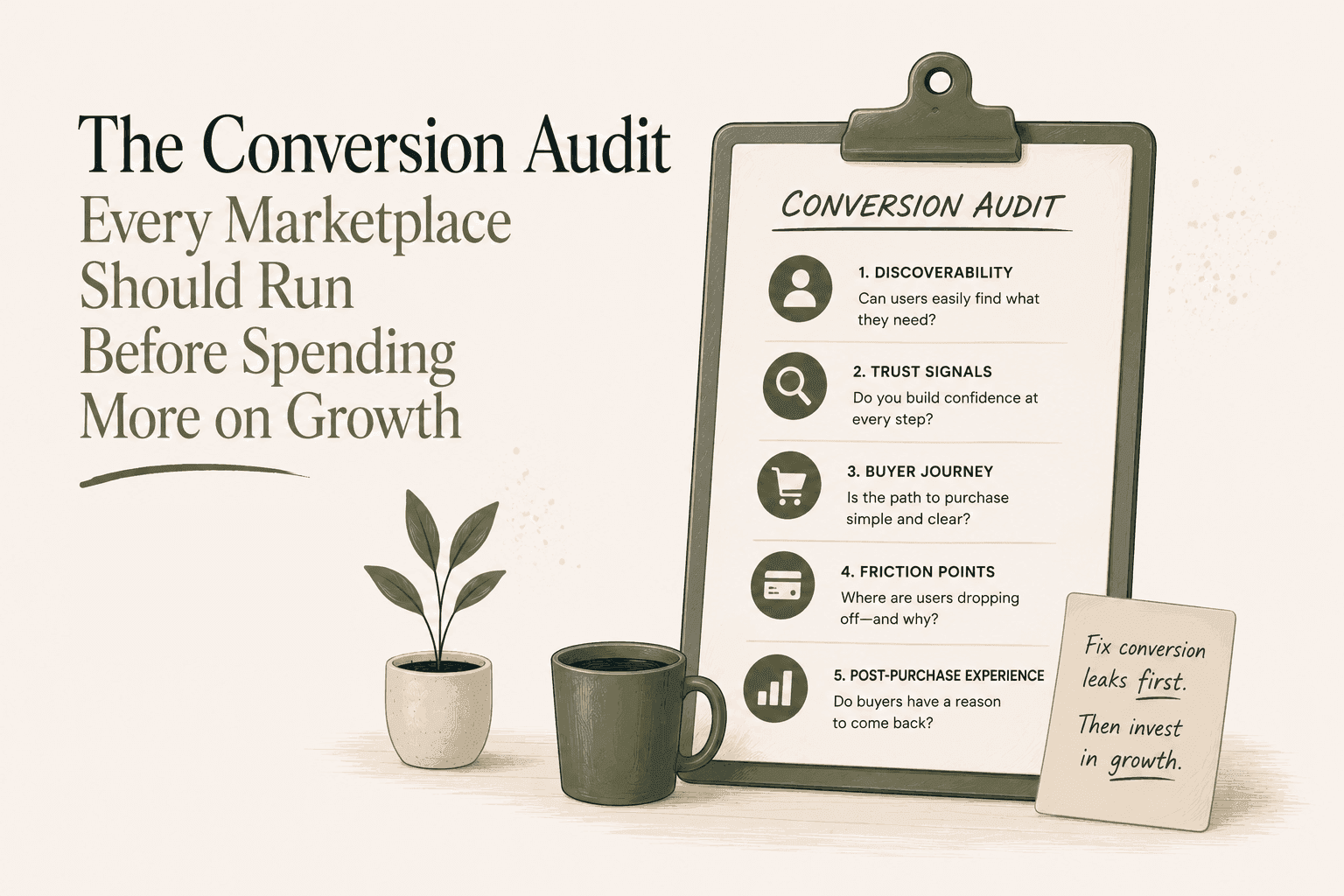
The most common mistake in marketplace growth is spending on acquisition before fixing conversion.
The logic for spending is easy to construct. Traffic is low. Bookings are low. Therefore: get more traffic. What this reasoning misses is that conversion rate problems compound with volume. Sending more buyers into a funnel that converts at 1 percent gives you more transactions, but it also gives you 99 buyers who arrived, did not book, and may never return. Every one of those is a paid acquisition you funded and then wasted.
A conversion audit identifies where your marketplace is losing buyers before you spend another dollar on acquisition. It takes a day to run. The fixes it surfaces take weeks to implement. The alternative is spending on growth for months before realizing the funnel was never ready.
Here is the framework.
Why Conversion Comes Before Acquisition
Most marketplace growth funnels have more conversion problems than acquisition problems. This is not obvious because acquisition metrics are easier to see. Cost-per-click, impression volume, and traffic numbers are visible in every dashboard. Conversion rates at specific funnel stages are harder to isolate, especially when the funnel spans multiple sessions and includes offline steps like communication with a supplier.
The five stages of a marketplace funnel each have a conversion rate. The overall booking rate from new visitor to completed transaction is the product of those five rates. Improving the worst-performing stage by 20 percent has a larger impact on total bookings than increasing acquisition volume by 20 percent, because the conversion improvement applies to all existing traffic, not just the incremental traffic you pay for.
The marketplace flywheel compounds when conversion is healthy. Better conversion means higher supply earnings, which retains supply, which improves selection, which improves conversion further. Every dollar spent on acquisition gets more efficient as the funnel tightens.
The 5-Stage Audit Framework
Stage 1: Discovery to Landing
At this stage you are measuring whether buyers can find your marketplace at all.
What to measure: Organic search rankings for your core category and location queries. Branded search volume. Direct traffic as a percentage of total. Referral traffic sources.
What good looks like: Your marketplace appears on page one for your primary category and location combinations. Branded search volume is growing month-over-month. You have at least one referral traffic source that is not paid.
Common failure modes: The platform ranks for branded queries only, meaning buyers already have to know you exist to find you. Category and location pages are thin or missing entirely. AI search returns no reference to the platform when answering buyer questions in your category.
Stage 2: Landing to Listing
At this stage you are measuring whether buyers who arrive can find the supply they are looking for.
What to measure: Homepage and category page bounce rate. Search and browse usage rate on landing pages. Time from arrival to first listing view. Search zero-results rate.
What good looks like: Most buyers who land on a category page view at least one listing within the same session. Search returns relevant results with few zero-result queries. The browse and filter experience surfaces supply in the buyer's actual geography and category.
Common failure modes: The homepage prioritizes brand messaging over supply discovery. Category pages show national or irrelevant supply rather than local or contextually relevant supply. The search function returns poor results for natural language queries. Filters are missing for the dimensions buyers care about, such as availability window, price range, or specific service attributes.
Stage 3: Listing to Intent
At this stage you are measuring whether listing pages convert browse behavior into purchase intent.
What to measure: Listing page to inquiry or booking initiation rate. Time spent on listing page. Photo and review engagement. Price page visits as a percentage of listing views.
What good looks like: Buyers who view a listing for more than 30 seconds initiate contact or booking at a meaningful rate. Review coverage is sufficient that buyers can evaluate trust before committing. Pricing is clear enough that buyers do not need to inquire about it before initiating a booking.
Common failure modes: Listing pages have weak photography, sparse descriptions, or no reviews. Poor listing photos are one of the most reliable conversion killers in marketplace platforms. Pricing is hidden or requires a quote request. Trust signals like verified status, response rate, or booking history are absent or buried.
Stage 4: Intent to Transaction
At this stage you are measuring whether buyers who want to book actually complete the booking.
What to measure: Booking flow completion rate. Drop-off points within the checkout flow. Payment method coverage. Cart or booking abandonment rate.
What good looks like: Most buyers who initiate a booking complete it. The booking flow has no more than four steps. Payment options cover the methods your buyer segment uses. Abandonment is concentrated at the final confirmation step rather than early in the flow.
Common failure modes: The booking flow requires account creation before showing price or availability. The flow asks for information not needed to complete the transaction. Payment options are limited to one method. The flow times out or has bugs on mobile. Required communication with the supplier before booking, rather than after, creates friction that kills intent.
Stage 5: Transaction to Repeat
At this stage you are measuring whether buyers who complete a transaction come back.
What to measure: First-to-second transaction rate by cohort. Time between first and second transaction. Post-booking communication quality. Review submission rate.
What good looks like: At least 30 to 40 percent of buyers complete a second transaction within 90 days of their first. Post-booking communication from the supplier is timely and professional. Buyers are prompted to review at the right moment, shortly after the transaction completes, and a meaningful percentage do.
Common failure modes: The post-booking experience is abandoned by the platform. No communication template or expectation is set for suppliers on how to communicate after booking. Review solicitation is generic or arrives too early or too late. The buyer has no reason to return to the platform rather than booking the same supplier directly.
How to Prioritize Fixes
Not every conversion problem deserves equal attention. Use an impact-by-effort matrix to sequence the work.
High impact, low effort: Listing quality issues (missing reviews, poor photos, incomplete descriptions), pricing transparency, trust signal display, and search result relevance improvements. These fixes are often content or configuration changes, not engineering work.
High impact, high effort: Booking flow restructuring, search algorithm improvements, and geo-filtering for supply discovery. These move the needle the most but take longer. Prioritize based on which funnel stage has the largest drop-off.
Low impact, any effort: Cosmetic design changes, header copy adjustments, and any fix to a stage where your conversion rate is already at benchmark. These are distractions until the high-impact problems are resolved.
Run the audit by stage, in order, and fix the worst-performing stage before moving to the next. The compounding math rewards fixing early-funnel problems first, because a higher percentage of buyers reach the later stages where your later-stage improvements also apply.
The Signal That You Are Ready to Spend
You are ready to scale acquisition spend when the conversion rate at each funnel stage is at benchmark or trending toward it, your first-to-second transaction rate is healthy, and incremental buyers from a test campaign convert at a rate that makes the unit economics work.
If those conditions are not met, more acquisition spend will not solve the problem. It will make the metrics look better while the underlying funnel problems become harder to diagnose against the noise of higher volume.
Running the conversion audit before building your acquisition strategy is the sequence that makes growth efficient. Fix the funnel first. Then fill it.
Once the funnel is healthy, the channel strategy in how to acquire your first 100 buyers becomes the right next step. And once you have buyers converting, retention vs. reactivation covers where to put the demand-side budget to keep them.
For marketplace operators who want to run this audit with a structured process and benchmark data from comparable platforms, the Product and Operations service includes conversion audits as a core engagement.