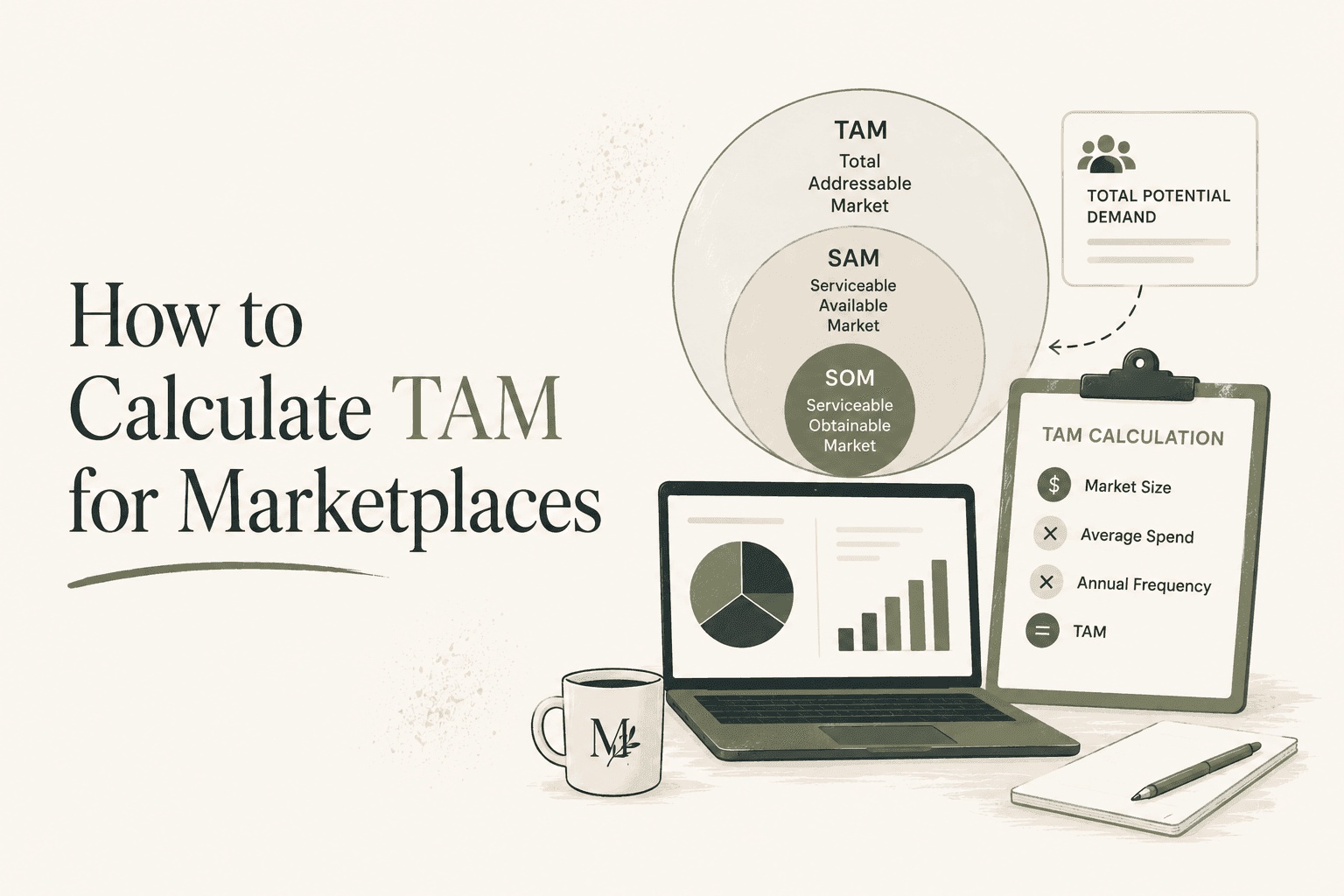
Total Addressable Market (TAM) is a critical early calculation for marketplace founders seeking investment. Many founders either overestimate TAM using broad industry figures or underestimate it by confusing TAM with their platform's revenue share.
The core principle: if every transaction in your category happened through your platform, what would the total GMV be?
TAM Is Based on GMV
Marketplaces facilitate transactions rather than owning products or services. Therefore, TAM should be expressed as total Gross Merchandise Value (GMV) for the category, not revenue. Once GMV TAM is determined, revenue TAM can be calculated by applying your take rate.
This distinction matters more than founders realize. Conflating GMV and revenue when sizing your market will undermine your pitch and your internal planning.
Three TAM Calculation Methods
1. Top-Down TAM (Broad but Useful)
This approach begins with industry research and progressively narrows scope.
Example: Global micro-mobility valued at $6B, with short-term leisure representing 30%, yields approximately $1.8B annual GMV TAM.
While helpful for framing, this method lacks sufficient specificity for independent reliance. Investors have seen enough top-down TAMs to be skeptical of them on their own. Use it as context, not your primary argument.
2. Bottom-Up TAM (Most Investor-Trusted)
This method builds from realistic assumptions about supply and earning potential.
Formula:
- TAM = (number of rentable units or providers) × (average yearly GMV per unit or provider)
- Revenue TAM = GMV TAM × take rate
Example: 7,500 bike owners and shops × $5,000 GMV annually = $37.5M GMV TAM. At a 20% take rate, Revenue TAM is approximately $7.5M.
This approach requires understanding the supply base and realistic provider earnings. It forces you to do the work, and that work also informs your supply acquisition strategy.
3. Geographic TAM (For Hyperlocal Marketplaces)
Individual cities operate as distinct markets with varying seasonality, customer density, tourist activity, and pricing. For hyperlocal models, sum your viable markets directly:
- San Francisco: $4M GMV
- Austin: $2.5M GMV
- Denver: $1.8M GMV
- Miami Beach: $3M GMV
This method applies especially to ride-sharing, gear rentals, tourism experiences, and location-dependent services. It provides the most honest sizing but may underestimate your scaling potential.
TAM Is a Planning Tool, Not a Vanity Metric
TAM for marketplaces is not guesswork. It is a structured view of the economic activity your platform can realistically organize.
Founders who calculate TAM correctly end up with better supply acquisition targets, clearer unit economics, and more defensible investor conversations. Founders who skip it or inflate it usually discover the gap when it matters most.
Do the bottom-up version first. Understand your supply base, what they earn today, and what they could earn through your platform. That number tells you more than any industry report.