
Marketplace Playbook Series: Seeding Supply in a Cold-Start Marketplace
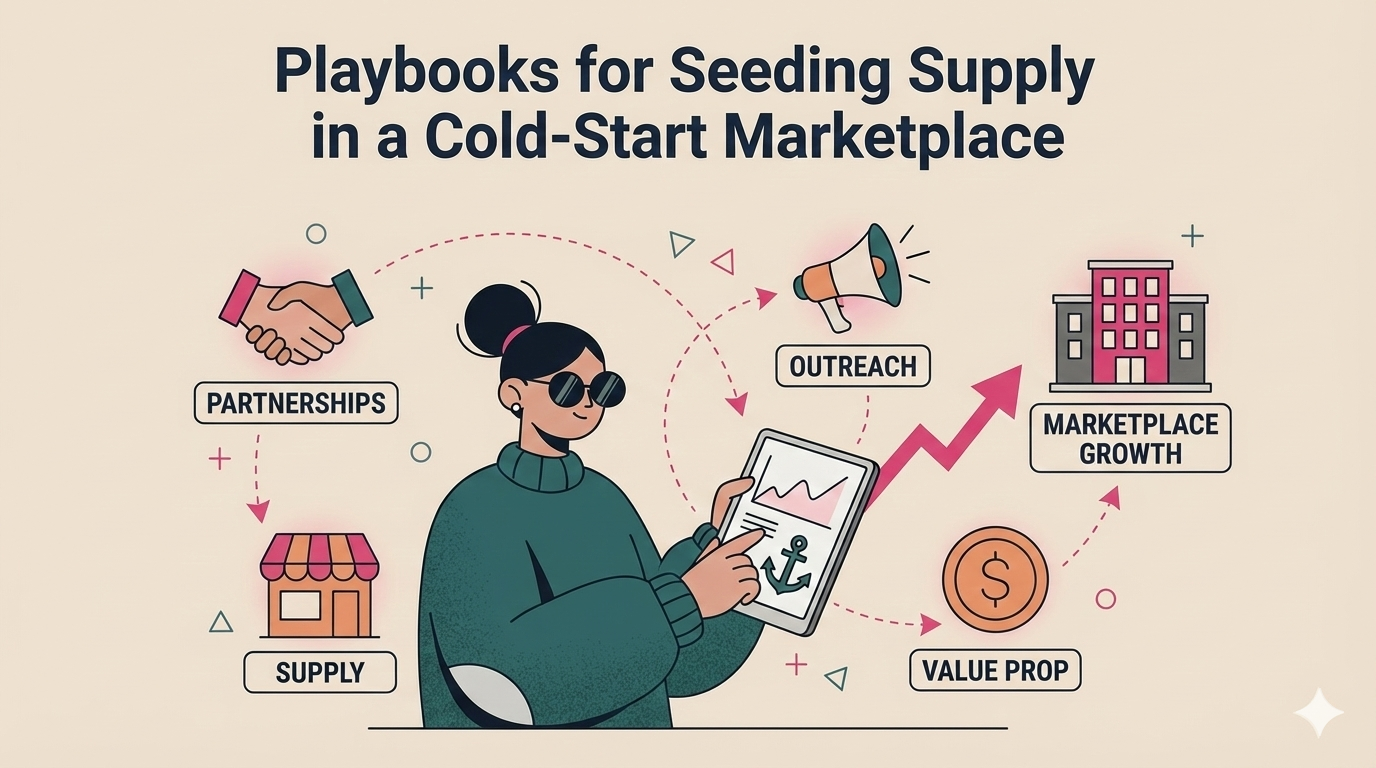
Most marketplace founders underestimate just how fragile the early days really are.
They launch, turn on demand, and hope supply shows up quickly enough to meet it. Sometimes it does. More often, buyers encounter empty listings, slow responses, or mediocre options. Trust erodes before the marketplace ever gets a second chance.
In a cold-start marketplace, supply is the product. Demand only converts if what buyers find feels intentional, credible, and immediately usable.
What follows are practical playbooks for seeding supply before demand, drawn from what actually works when you have no liquidity, no brand, and no momentum yet.
Manual Outreach: Do the Work That Teaches You What Matters
Early on, automation is a distraction. You don’t yet know what great supply looks like, and you can’t outsource judgment.
Manual outreach gives you clarity. Personally identify ideal suppliers, reach out one by one, and have real conversations about how they operate today. You’ll often onboard them manually, outside your product, using spreadsheets, emails, and calls.
This isn’t about scale. It’s about calibration.
Manual outreach answers foundational questions:
Which types of suppliers succeed in this market?
What do buyers need to see to trust them?
Where do current workflows break down?
What pain points do suppliers feel most acutely?
Just as important, it lets you curate early supply. You can say no. You define what “good” looks like before the market does.
If your onboarding process already feels too polished, you’re probably moving too fast.
Define Your Supply-Side Value Props Before Demand Shows Up
Suppliers don’t join marketplaces out of curiosity. They join because the offer makes economic or operational sense right now.
Before demand arrives, build a clear hypothesis for why a supplier would say yes, and test it directly in conversations.
Common value propositions for early supply:
Access to incremental revenue
Higher-quality customers with real budgets
Less time on sales, quoting, or admin
Better utilization of idle capacity
Faster, more reliable payments
Brand exposure or credibility
What matters isn’t which value prop you pick, it’s which one resonates with each segment of supply.
A shop with idle capacity cares about volume. A premium supplier who’s already booked may care more about filtering and quality.
These hypotheses will evolve. That’s the point. The goal early on isn’t to be right, it’s to learn fast. Over time, patterns emerge, and those patterns shape your messaging, onboarding, and eventually the product itself.
If you can’t clearly explain why supply should join before demand exists, adding demand won’t fix it, it’ll just expose the gap faster.
Partnerships: Borrow Access, Not Just Attention
Early partnerships aren’t about logos or announcements — they’re about access to pre-qualified supply.
The best partners already sit close to your ideal suppliers:
Industry associations
Software platforms suppliers already use
Service providers embedded in their workflow
A strong partnership works even when your marketplace is tiny. It should help suppliers win, whether through incremental revenue, operational efficiency, or better customers.
Avoid partnerships that only pay off at scale. Early-stage partnerships must deliver tangible value when you have ten suppliers, not ten thousand.
One well-aligned partner can seed more quality supply than months of cold outbound.
Anchor the Market With One Supplier Who Matters
One of the most underused marketplace tactics is anchoring supply around a single, high-credibility supplier.
An anchor supplier:
Is respected in the niche
Consistently delivers quality
Is open to close collaboration in the early days
You can build your initial marketplace around this supplier:
Shape listings around their workflow
Route early demand exclusively to them
Refine pricing, expectations, and UX together
Buyers don’t need variety at first, they need confidence. One excellent supplier creates more trust than ten average ones.
Once demand proves real for the anchor, expansion becomes easier. New suppliers join because the marketplace works, not because you’re still promising it will someday.
Pre-Seeding Supply: Powerful, Risky, and Easy to Get Wrong
Some founders use pre-seeding to break the chicken-and-egg problem, creating supply profiles using public data or indexing known providers before they formally onboard.
Done carefully, this can make your marketplace look less empty. Buyers want to see supply; supply wants to see demand.
But this only works if you can convert that visibility into real transactions.
The safest version happens when you already have a paying customer. You approach a supplier and say: “I have a real job, real budget, and a real buyer. Do you want it?”
Used this way, pre-seeding becomes a bridge, not a bluff.
It fails when buyers engage with fictional or unreachable suppliers. If a customer can’t get fulfillment, trust evaporates, and in an early marketplace, you rarely get it back.
Pre-seeding can accelerate learning, but it should never outrun your ability to deliver.
Supply Is Not a Monolith
The through line across all of this: supply is never one thing.
Different suppliers want different outcomes. Different stages demand different incentives. The value props that work in month one rarely scale into year two.
Your job early on isn’t perfection, it’s clarity.
Clarity around:
Who your ideal supply really is
What they value right now
What risks you’re asking them to take
What you can credibly deliver in return
Get that right, and layering in demand becomes easy. Get it wrong, and no amount of demand will save the marketplace.
Stuck on something?
If you’re building a marketplace and feeling stuck, I help founders work through real problems with practical, paid advisory support. Share a few details below and we’ll start with a free 15-minute intro call to discuss your challenges and see if working together makes sense.
